TPO vs. PVC Roofing: A Commercial & Industrial Building Owner’s Guide for Jacksonville and Northeast Florida
If you manage a flat or low-slope commercial or industrial building in Northeast Florida — a warehouse, distribution center, hotel, multifamily property, church, or manufacturing facility — chances are you’ve received bids for both TPO and PVC roofing. On paper and from the ground, they look nearly identical. Both are white, heat-welded, single-ply membranes. Both carry 15- to 25-year manufacturer warranties. Both meet Florida Building Code requirements when installed correctly.
So why does one bid come in higher than the other, and does the difference actually matter for a building you may own for the next one, five, or thirty years?
It does — and the answer depends on your roof’s exposure, your ownership timeline, and how much movement your structure sees. Below, we break down what separates these two membranes so you can walk into your next roofing decision with the same information we use when we’s specifying a system for a client’s building.
What TPO and PVC Have in Common
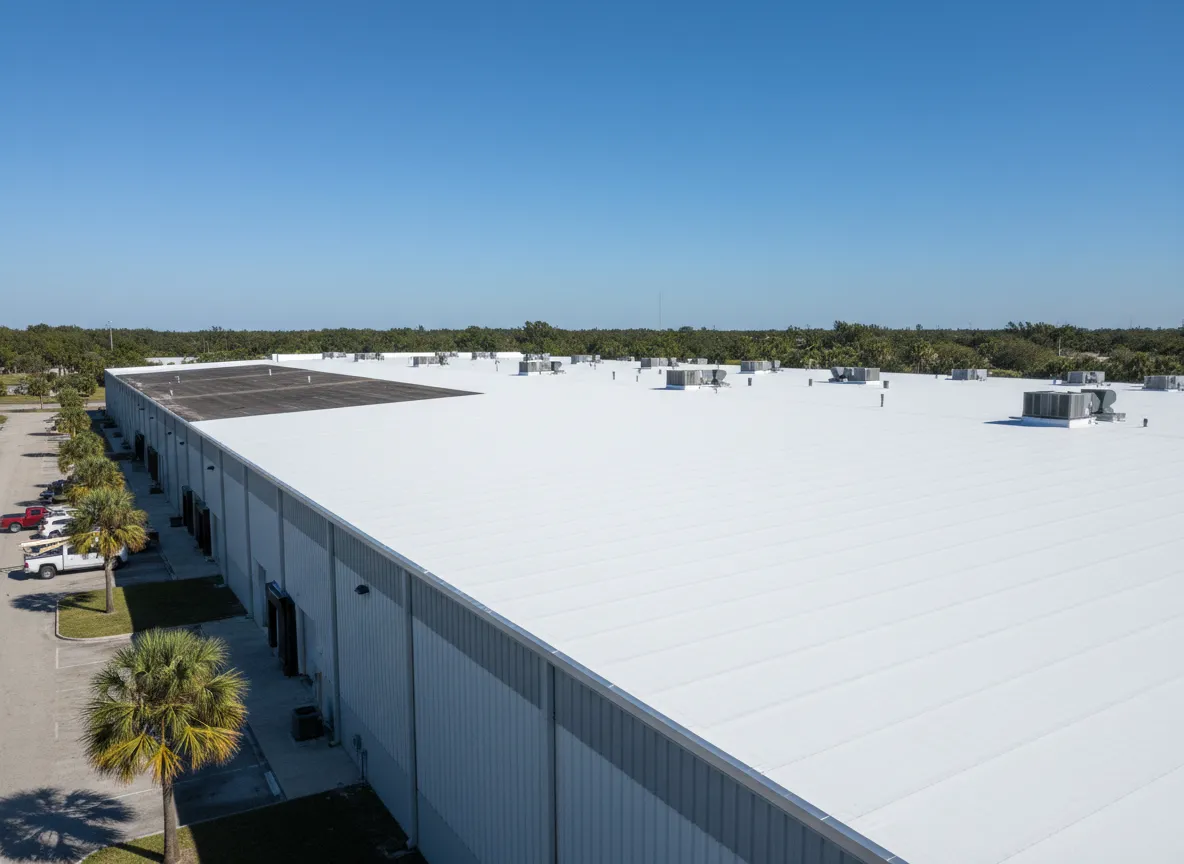
TPO (thermoplastic polyolefin) and PVC (polyvinyl chloride) are both single-ply thermoplastic membranes. The word “thermoplastic” is the key detail: seams are fused using hot-air welding equipment rather than glued, taped, or torch-applied. A properly welded seam becomes as strong as the sheet itself, which is a major reason both systems have replaced built-up roofing (BUR) and older modified bitumen assemblies on much of Jacksonville’s commercial building stock.
Beyond the welding process, the two membranes share several traits:
- Reflectivity. Both are manufactured in white (and other colors) with high solar reflectance, which helps lower rooftop surface temperatures and cooling loads — a meaningful factor in a climate where roof surface temperatures regularly exceed 150–170°F for much of the year.
- Installation methods. Both can be mechanically fastened, fully adhered with bonding adhesive, or induction-welded to the deck, depending on wind uplift requirements, deck type, and insulation strategy.
- Code compliance. Both meet Florida Building Code (FBC) and Miami-Dade/High Velocity Hurricane Zone testing standards when the assembly — membrane, fasteners, insulation, and cover board — is engineered as a system, not just a membrane choice in isolation.
- Warranty structure. Manufacturers such as Duro-Last, GAF, Carlisle, Johns Manville, and Mule-Hide offer comparable warranty terms on both membrane types, though the fine print on prorated coverage, wind speed exclusions, and NDL (No Dollar Limit) status varies significantly and is worth reading carefully.
For a large share of buildings in Jacksonville, either membrane will perform adequately. The real differences show up in three areas: chemical exposure, long-term flexibility, and installed cost — and a fourth, less obvious factor: how much of the roof gets built in a factory versus on your roof deck in the Florida heat.
Where PVC Pulls Ahead
1. Grease, Oils, and Chemical Exposure
This is the single clearest reason to specify PVC over TPO. PVC membrane is inherently resistant to animal fats, cooking oils, and many industrial solvents. TPO is not — the plasticizers and polymer structure in TPO can soften, degrade, and delaminate when exposed to grease over time.
This makes PVC the default choice for:
- Restaurants and commercial kitchens with rooftop grease exhaust
- Food processing and cold storage facilities
- Airport-adjacent buildings exposed to jet fuel and de-icing residue
- Manufacturing plants with rooftop equipment that vents oils, solvents, or industrial chemicals
If your building has kitchen exhaust fans, fryer vents, or any rooftop equipment that discharges oil or chemical byproducts, PVC is not a preference — it’s close to a requirement. We’ve re-roofed buildings in Duval and St. Johns counties where a TPO membrane installed near a restaurant’s grease exhaust needed replacement years ahead of its warranty term because of exactly this issue.
2. Long-Term Flexibility and Seam Integrity
PVC membrane retains its plasticizers and stays pliable as it ages far better than TPO. That matters most on:
- Roofs with significant thermal movement (large metal decks, buildings with expansion joints)
- Older structures that have already weathered multiple hurricane seasons
- Retrofit projects over standing-seam metal, where the substrate itself moves with temperature swings
A membrane that stays flexible keeps its seams intact. Seam failure — not membrane puncture — is the most common cause of single-ply roof leaks, so anything that preserves long-term flexibility directly reduces your risk of a leak call five, ten, or fifteen years down the road.
3. Track Record
PVC has been used on commercial roofs since the 1960s, and its chemical formulation has been stable and well-understood for decades. TPO is a comparatively newer product. Early TPO formulations from the 1990s and early 2000s had well-documented problems with weathering, seam failure, and premature embrittlement, which is part of why some specifiers and insurers still carry a bias toward PVC on higher-value assets. Modern TPO formulations have improved substantially — reputable manufacturers have addressed most of the early failure modes — but the decades of proven field performance behind PVC is a real factor, not just a marketing point.
4. Factory Prefabrication (Duro-Last System)
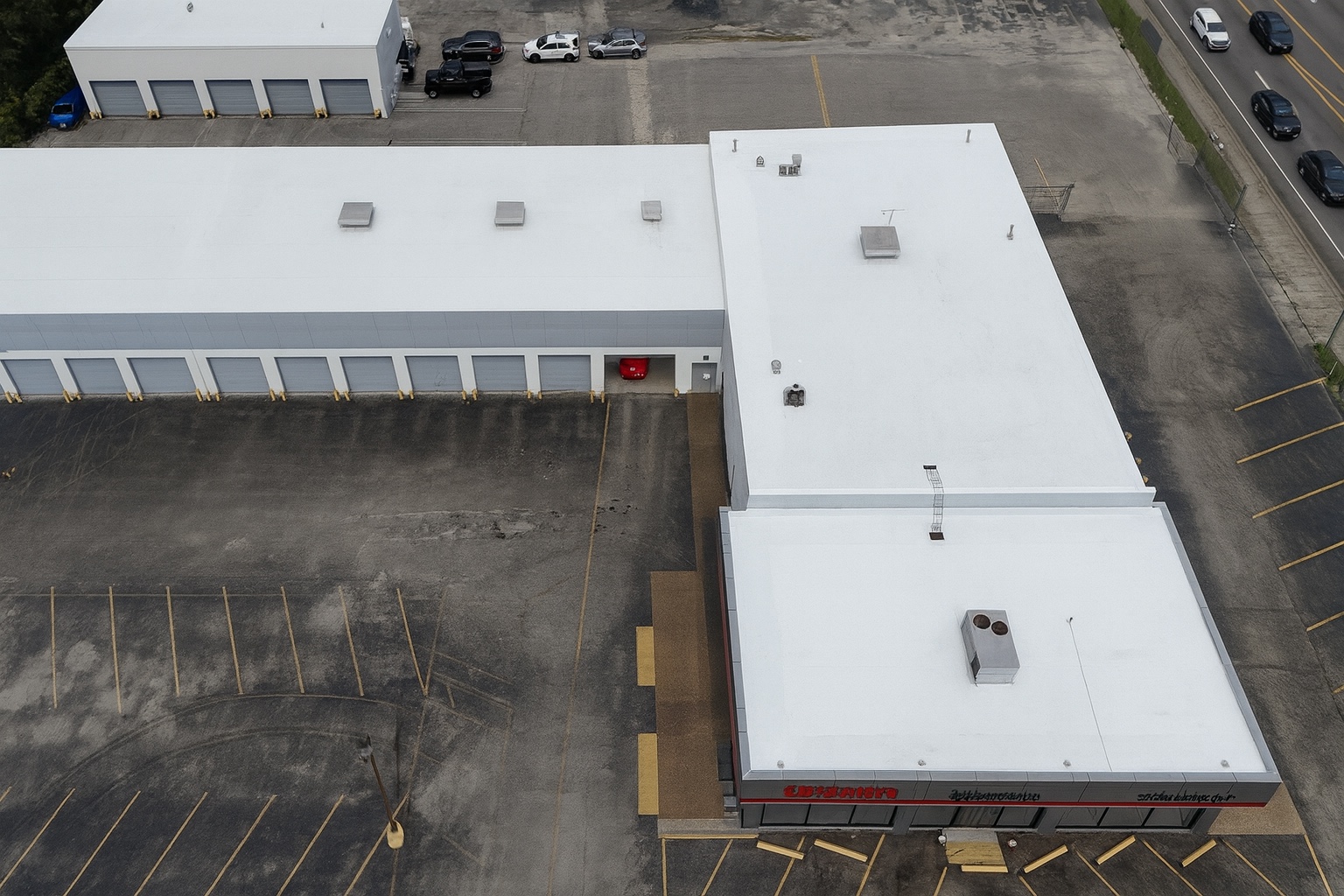
This is one of the most overlooked advantages of PVC roofing, and it’s a major reason SPC Roofers holds Duro-Last Platinum Contractor status. Duro-Last is a PVC system in which the majority of the roof — including corner flashings, curbs, pipe boots, and drain details — is custom-prefabricated in a factory to your building’s exact measurements before it ever arrives on site.
Roughly 80–85% of the total welding happens in a controlled factory environment rather than on your roof deck in Jacksonville’s August heat and humidity. That matters because:
- Fewer field seams mean fewer opportunities for a weld to fail
- Factory welds are made under consistent temperature, pressure, and quality-control conditions — not weather-dependent
- Complex penetrations and curb details, which are the most leak-prone areas of any roof, are largely eliminated as field-welding tasks
- Installation timelines shrink, reducing the number of days your roof deck is open to weather
Where TPO Makes Sense
1. Installed Cost
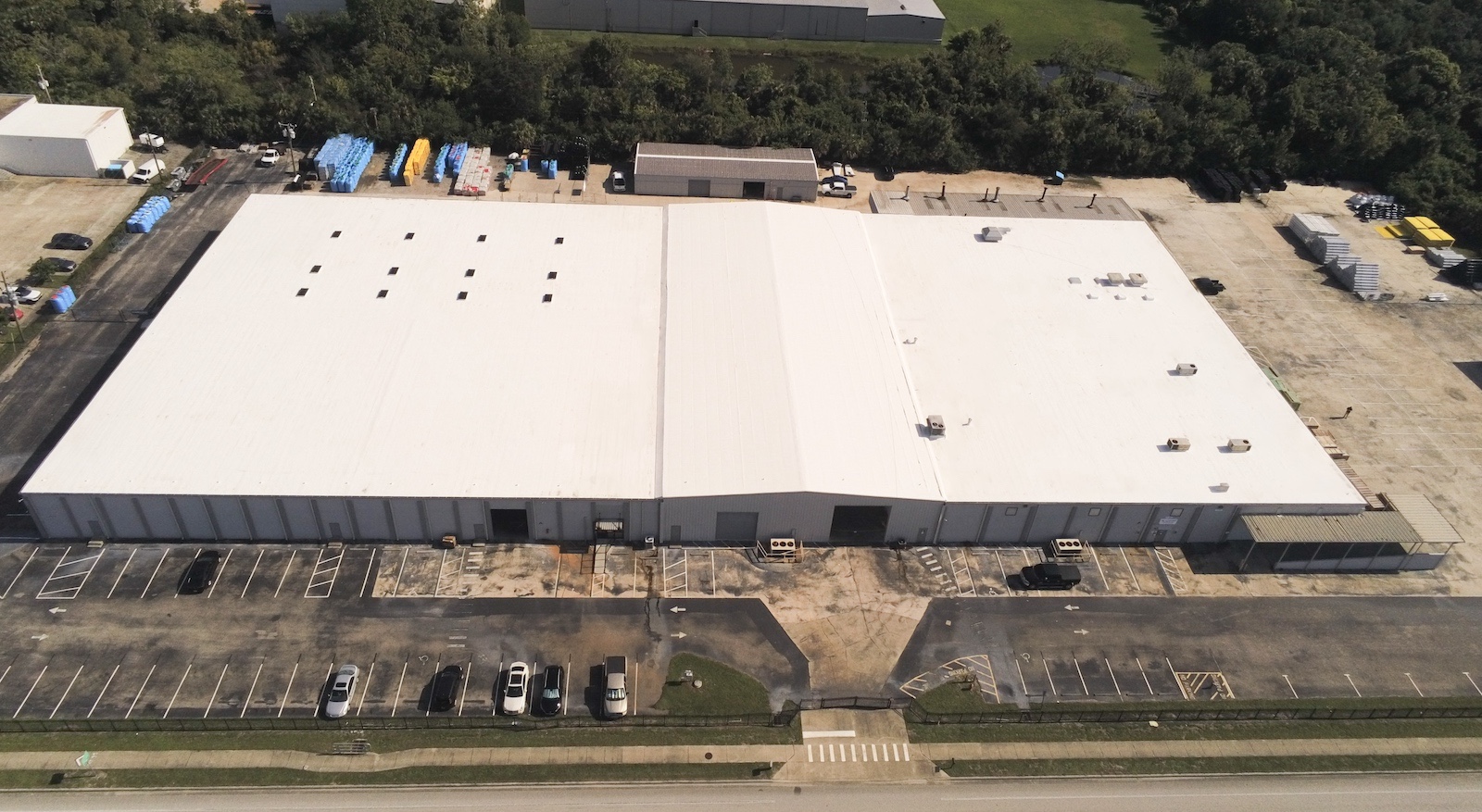
TPO typically installs for less per square than PVC, primarily because of resin cost and manufacturing volume. On a large, simple roof — a big-box warehouse, distribution center, or flex industrial building — that cost gap can add up to a meaningful capital savings. That said, the price gap between quality TPO and PVC has narrowed in recent years, and it’s often smaller than owners expect once you account for a full system (insulation, cover board, fastening pattern, and warranty tier).
2. Simple, Low-Exposure Roofs
If your building is a straightforward rectangle with a handful of rooftop HVAC units, no kitchen exhaust, and no chemical or grease exposure, a quality TPO membrane from a reputable manufacturer will perform well through its warranty term. This is a common and appropriate specification for many Jacksonville warehouses, offices, and light industrial buildings.
One nuance worth understanding: PVC roofs frequently outperform their advertised warranty length in the field. TPO less reliably does the same. If you’re holding the property long-term, that difference compounds. But if you have a defined exit strategy — say a five-to-seven-year hold before a sale or repositioning — a well-installed TPO system with a transferable warranty can be the more capital-efficient choice, since you’re not paying for 20+ years of performance you won’t own the building long enough to use.
3. Reflectivity and Energy Performance
Both membranes are available in highly reflective white, but TPO frequently posts very strong initial solar reflectance index (SRI) ratings from manufacturers. In a climate like Jacksonville’s, where roof surfaces run hot nine months out of the year, a highly reflective membrane measurably reduces rooftop heat gain and can lower HVAC cooling loads — a real, ongoing operating expense benefit, not just an upfront cost consideration.
4. Environmental Profile
TPO does not contain chlorine or plasticizers, which makes it the preferred membrane for some ownership groups, REITs, and sustainability programs pursuing LEED or ESG-related building certifications.
Three Questions Every Jacksonville Building Owner Should Ask
When we sit down with a building owner or facilities manager to spec a roof, we walk through the same three questions every time:
1. What is going onto — or venting onto — this roof? Grease, fryer exhaust, chemical vents, or rooftop equipment that leaks oils or solvents point strongly toward PVC. A clean roof exposed to nothing but rainwater and normal HVAC condensate can reasonably go either way.
2. How long do you plan to own the building? If you’re holding for 20-plus years, the long-term flexibility and proven track record of PVC are usually worth the premium. If you’re repositioning the asset for a sale in five to seven years, a quality TPO system with a transferable warranty is often the smarter capital allocation — you get adequate protection without over-paying for performance decades you won’t hold the property to use.
3. How much structural movement does the building see? Older structures, long-span metal decks, buildings with a history of settling, and properties that have weathered multiple hurricane seasons all favor PVC’s superior long-term flexibility. Newer, more rigid structures have more latitude to consider either membrane.
There is no universal right answer, and we’re genuinely wary of any contractor who gives you one without asking these questions first. We’ve installed both systems across Duval, St. Johns, Clay, and Nassau counties, and throughout Florida and the broader Southeast. Both membranes perform well when the assembly is engineered correctly and the crew installing it actually knows how to weld it properly. The right system depends on your goals for the property — which is exactly what our team, including Matt Khosrozadeh, specializes in: tailoring a roofing system that stabilizes your capital expenditures and performs through your entire ownership cycle, not just through the length of a warranty booklet.
The Part That Matters More Than the Membrane Brand
After nearly 50 years of commercial roofing in Jacksonville, here’s what we’ve learned: the membrane brand is rarely the reason a roof fails. Roofs fail at the details — penetrations, curbs, edge metal, drains, and seams. A well-installed TPO roof will consistently outlast a poorly installed PVC roof, every time.
That’s precisely why we put so much emphasis on prefabrication and crew training, and why SPC Roofers holds Platinum contractor status with both Duro-Last and Owens Corning — tiers that are earned through documented installed performance, not sales volume. It’s also why our maintenance programs exist: a roof’s long-term performance depends as much on inspection, drain maintenance, and prompt small repairs as it does on which membrane sits on the deck.
Storm Damage, Insurance, and Long-Term Roof Health
Northeast Florida building owners carry an additional consideration that doesn’t apply everywhere: hurricane and tropical storm exposure. Wind uplift rating, fastening pattern, and membrane flexibility after repeated storm cycles all affect how a roof performs over its life — and how straightforward (or contentious) an insurance claim becomes after a major weather event. Our team works directly with building owners and their insurance adjusters after storm damage to document conditions accurately, which is a separate but related reason that installation quality and system documentation matter as much as the membrane spec itself.
Next Step
If you already have a bid in hand and want a second opinion on whether TPO or PVC is the right call for your building, we’re happy to review it. We’ll tell you honestly if the lower-cost option is the right fit for your situation — sometimes it is, and we’d rather earn your trust than pad a spec.
Call SPC Roofers at 904.349.1342 or request a free roof assessment, and we’ll have someone on your roof within the week.
SPC Roofers has been a family-owned commercial roofing contractor based in Jacksonville, FL since 1978, serving Duval, St. Johns, Clay, and Nassau counties and building owners throughout Florida and the Southeast. We are the only Duro-Last Platinum-rated and Owens Corning Platinum Preferred commercial roofing contractor in Northeast Florida. Florida licenses CCC1331077 and CGC013267.
1845 University Blvd, Jacksonville, FL 32211 | 904.349.1342 | jacksonvillecommercialroofers.com