Above & Beyond: How Drone Technology Is Changing Commercial Roof Inspections
The roof is the single most important envelope component of any commercial building and for too long, inspecting it meant risking lives, burning hours, and guessing at problems hiding in plain sight forty feet up.
Commercial roofing is one of the largest capital investments a property owner, manager, or developer will ever make. A single roof on a mid-size warehouse or retail center can represent hundreds of thousands of dollars in materials and labor. When something goes wrong, the downstream costs water damage, business interruption, insurance disputes can dwarf the original investment.
Yet for decades the standard approach to commercial roof inspection was deeply flawed: a technician on a ladder, walking the surface, scribbling notes, trying to photograph problems with a phone pointed into the sun. Slow, incomplete, and dangerous. That era is over.
SPC Roofers family owned and operated since 1978 has made drone technology a core part of how we inspect, assess, document, and advise on commercial roofing throughout Jacksonville and across Florida. The result is faster inspections, richer documentation, smarter insurance claims, and better decisions for everyone involved.
Why Commercial Roofs Demand a Bird’s-Eye View
Commercial roofs are a different animal than residential. They’re typically flat or low-slope, sprawling across thousands sometimes tens of thousands of square feet, with drainage channels, HVAC curbs, skylights, penetrations, expansion joints, parapet walls, and membrane seams running hundreds of linear feet. A traditional foot inspection on a large roof can take half a day and still miss problem areas, because the human eye at surface level can’t perceive subtle deflection, ponding patterns, or membrane blistering at scale.
Florida raises the stakes. The region sits in the path of Atlantic and Gulf storm systems, tropical depressions, and intense convective thunderstorms that can drop several inches of rain in an afternoon. Subtropical humidity and a year-round high UV index break down roofing materials faster than almost anywhere else in the country. When a major event rolls through, the volume of simultaneous damage claims can overwhelm traditional inspection capacity overnight.
A drone doesn’t get tired. It doesn’t slip on a wet membrane. It captures the entire roof surface in a single pass with consistent, calibrated imaging and delivers documentation that holds up in an insurance claim, a contractor bid, and a capital-planning spreadsheet.
What an SPC Roofers Drone Inspection Actually Captures
Plenty of companies have adopted drones as a marketing prop — a consumer quadcopter buzzing around a building for some pretty PDF photos with little analytical value. We take a different approach, using professional-grade equipment operated by trained technicians to generate data you can act on.
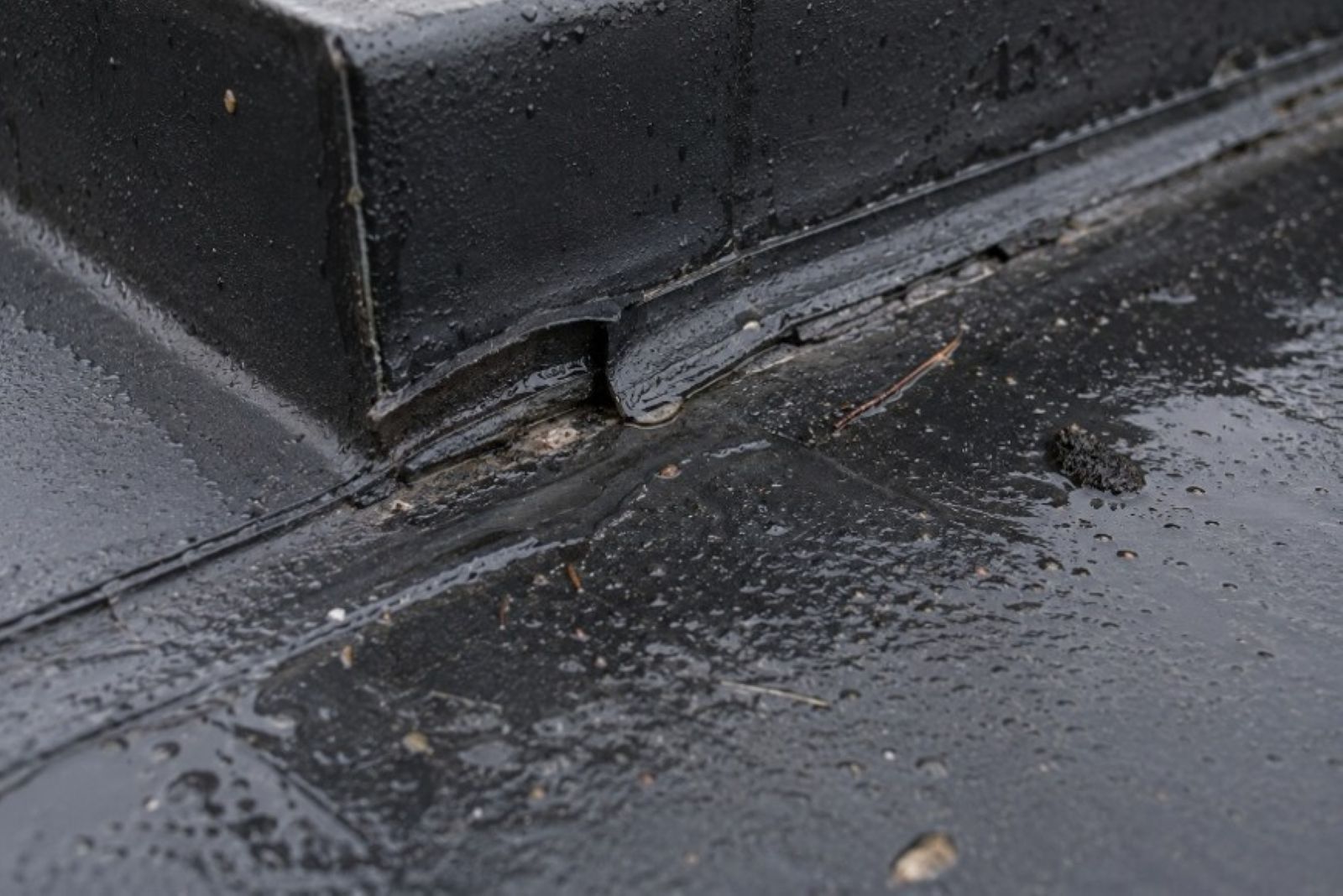
High-resolution optical imaging. We capture detailed imagery at multiple altitudes and angles — wide overview shots that communicate overall condition, plus tight close-ups of specific defects: punctures in a TPO membrane, failed lap seams on a modified bitumen system, deteriorated parapet flashing, clogged drains creating ponding. Every image is GPS-tagged and timestamped, creating a precise, defensible record of the roof now of inspection.
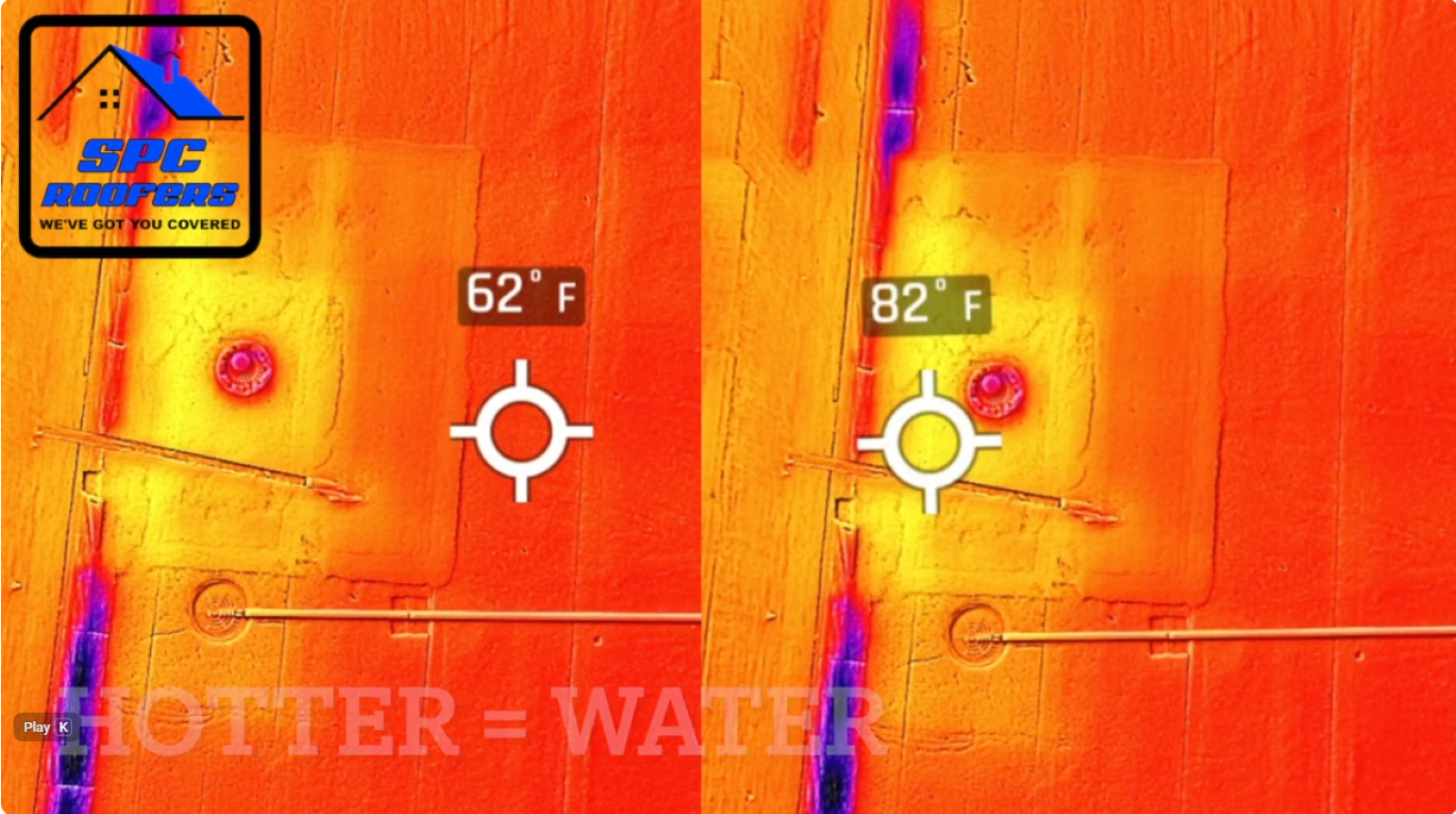
Thermal infrared imaging. This is where drones genuinely outperform any traditional method. Wet insulation retains heat differently than dry insulation, so a thermal scan taken in the late afternoon after the roof has absorbed heat all day reveals subsurface moisture as warm areas against a cooler, dry background. Mapping moisture this way is impossible from the ground and painfully tedious on foot. A drone-mounted thermal sensor sweeps an entire roof in minutes and produces a complete moisture map that directs targeted repairs instead of speculative tear-off.
Ortho mosaic mapping and measurement. By flying a systematic grid and processing the images through photogrammetry, we generate a scaled, georeferenced Ortho mosaic, a precise aerial photograph of the entire roof from directly above. It can be measured: square footage, linear feet of seams and flashings, ponding-zone area, drain spacing. That eliminates manual measurement error and gives adjusters, managers, and other contractors an authoritative reference with no ambiguity.
HD video documentation. Alongside the data products, we capture full-inspection video. It shows the roof in context, makes findings easy to understand for owners who don’t want to parse a technical report, and provides timestamped visual evidence that’s hard for an adjuster to dispute.
From First Call to Final Report: The SPC Process
Step 1 — Consultation and scope. Every engagement starts with understanding the property’s history, your concerns, known problem areas, and the purpose of the inspection: routine assessment, storm documentation, pre-purchase due diligence, or insurance renewal. This shapes the flight plan and report format.
Step 2 — Pre-flight planning and airspace check. We confirm site access, identify obstructions and equipment locations, verify weather and lighting conditions, and clear any airspace requirements before wheels-up — so the survey is safe, legal, and efficient.
Step 3 — Aerial survey and data capture. The drone runs a systematic, multi-altitude survey: high overview passes for context, then detailed close-ups of seams, flashings, penetrations, drains, HVAC curbs, and parapet edges. Thermal passes happen at the optimal time of day. The entire session is logged and timestamped.
Step 4 — Ground-level verification. Drone inspection is a force multiplier, not a replacement for boots on the roof. Where the survey flags anomalies, our experienced technicians verify findings on the roof — probing suspected moisture and assessing deck condition in problem zones. Targeted verification is far more efficient and less disruptive than a full manual sweep.
Step 5 — Data processing and analysis. Raw imagery becomes Ortho mosaic maps, thermal overlays, and annotated photo reports. Each defect is catalogued with location, photo documentation, severity, and recommended action. This is where more than four decades of roofing expertise turns a thermal anomaly into a meaningful diagnosis because knowing what the data means requires deep domain knowledge, not just the ability to fly.
Step 6 — Comprehensive report delivery. You receive an executive summary of overall condition, annotated aerial and thermal imagery, an itemized defect log with severity ratings and locations, prioritized recommendations with estimated repair scopes, and where applicable packages formatted for insurance submission or transaction disclosure.
Who Benefits, and How
Property and business owners finally understand the true condition of their roof before problems become emergencies. Capital budgets get prioritized on data, not guesswork; repairs get planned rather than reacted to; warranties stay protected through documented maintenance. A verified roof-health record can even support appraised value at sale or refinance. And it lets you avoid the premium cost of emergencies a defect caught in a routine flight might cost a few thousand dollars; the same defect discovered after rain pushes water into a warehouse of inventory can cost many multiples of that across building repair, inventory loss, business interruption, and deductible exposure.
Insurance carriers and adjusters get pre-loss condition baselines that distinguish genuine storm damage from pre-existing wear, plus organized post-storm packages that speed accurate determinations. That reduces adjustment labor for carriers and accelerates resolution for policyholders.
Investors and lenders get an objective, quantified roof assessment that informs acquisition pricing, capital reserves, and disclosure obligations. Lenders increasingly require third-party roof condition reports for commercial financing in storm-exposed markets and a report from a credentialed contractor satisfies that requirement with documentation they trust.
Experience Meets Technology: The SPC Difference
A drone is a tool. Its value depends entirely on the expertise behind it. SPC Roofers holds certifications and partnerships with leading manufacturers GAF, Owens Corning, Fiber Tite, Elevate, Mule-Hide, and Duro-Last, giving our technicians deep knowledge of how different systems age, fail, and respond to Florida’s climate. When a thermal image shows a subtle anomaly at a seam, we know whether it’s a failed weld, a manufacturer defect, or a normal differential caused by equipment underneath. That interpretive expertise is what turns data into intelligence.
We’ve been family owned and operated since 1978, building this business on honesty and lasting relationships. We’re fully insured, certified, and licensed, we back our work with a lifetime workmanship guarantee, and our inspections and estimates are free.
Ready to See Your Roof from Above?
Whether you’re prepping for hurricane season, documenting a storm claim, planning a capital replacement, or you simply don’t know what shape your roof is in SPC Roofers can give you the answers.
Call (904) 647-5945 for a free drone-assisted inspection today.